research
Below is written and video summaries of my 2023 study “how does improvisation evoke a neurological response in jazz musicians?”
How does improvisation evoke a neurological response in jazz musicians?
The genre of jazz is characterised by intricate rhythms, swing feel, complex harmony and perhaps most significantly, the idea of improvisation. While playing a tune, jazz ensemble members will often take turns in soloing over the piece’s chordal progression. This requires an understanding of the piece and its harmonic structure, rhythmic feel and form, as well as a pre-established vocabulary of scales, lines and licks. Within a jazz solo, these pre-learned lines along with spontaneously created patterns, are combined to produce a musical idea that has never been heard before. Developing a library and knowledge of notes and patterns to use in certain musical contexts takes time and practice, and is often compared to learning basic phrases in a new language in order to gradually reach fluency.
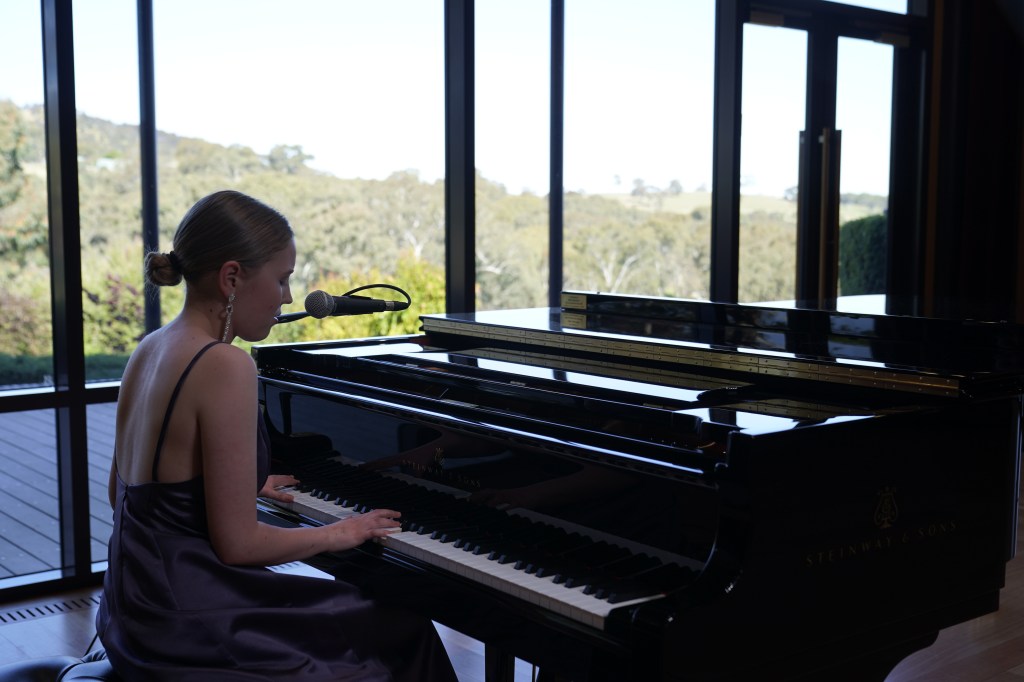
As I outline my key findings while studying the neurological effects of improvisation, you will be able to see and hear me conducting my own improvisation over a selection of jazz standards (see video below). The aim of this was to not only supplement my research, but to allow an opportunity for me to develop, apply and analyse my own improvisation.
Improvisation relies on pre-learned patterns that are utilised within ongoing improvisation. An improvisor has an established knowledge of these patterns along with ways of combining and linking them, methods and restrictions when generating new patterns, how they relate to the harmony and rhythm of the piece, physical movements required to play the patterns, as well as information about the performance and stylistic contexts. This type of creativity requires the continuous action of idea generation and regeneration, as well as the execution of these ideas. This is affiliated with specific brain network functionality and activation.
Interactions between two major brain networks, default mode network (DMN) and executive control network (ECN) are believed to contribute to the creation and evaluation of musical ideas in improvisation.
The DMN consists of interacting brain regions that are activated when someone is not focused on their surroundings or the outside world. DMN activity can be measured with functional MRI. Two of the critical nodes in the DMN are the ventromedial prefrontal cortex which plays roles in decision making, emotion regulation, morals, empathy and impulse control,[1] along with the posterior cingulate cortex, which is involved in self-referential thought and memory recollection.[2]
The ECN is responsible for tasks and decision making.[3] It is involved with and contributes to and facilitates, problem-solving, processing information, behaviour by drive or preference, visually learnt behaviours, and external thinking.
Within improvisation, ideas are considered and evaluated, then utilised in ongoing improvisation through the ECN. The cortices in the ECN include the dorsolateral prefrontal cortex and the dorsal parietal cortex. These cortices help prepare and conduct response to stimuli when it is goal-directed. The information and ideas created, travel from the DMN and intervention from the ECN enables the ideas to be executed. The context of improvisation can impact activation in certain areas of the ECN, notably the dorsolateral prefrontal cortex. Typically, increased constraints such as improvisation based on the song’s written melody, lead to increased activation. [4]
When comparing brain activity between pre-learned and improvised repertoire, improvisation was shown to cause an increase in DMN activation alongside a decrease in ECN activation. The deactivation of ECN regions was described as hypofrontality, which relates to the flow state, which will be elaborated on later.
On the other hand, when subjects’ brain activity was monitored while improvising or interacting with another instrumental player, the ECN activation increased in areas that focus on language production, interrupting the flow state.4
In one test, improvisation was performed over a common 12 bar blues progression4, meaning the harmonic and general musical structure was very familiar, increasing the flow state due to fewer musical restrictions in the simple progression. The idea of a flow state is a psychological condition where one is completely immersed in a specific thing, oblivious to other thoughts, stimuli and the passing of time. The results during this improvisation experiment displayed a decreased connectivity between left frontal lobe, lateral premotor cortex, supplementary motor area and cerebellum. These results align with the theory of transient hypofrontality – which outlines that activity in the frontal regions of the brain is decreased[5] to in a sense, quieten voices inside your head and induce a flow state, commonly experienced in improvisation.
Another experiment[6] used jazz improvisation to study dynamic neural substrates during creativity. Neural substrates are often made up of a series of units which support functions within in the central nervous system.[7] The overview of the experiment results shows that both free or unrestricted improvisation and improvisation constrained to the motifs of the melody, led to a much higher probability of occurrence of a substrate including sensorimotor, auditory and posterior salience networks. The increased activation of these networks was compared to playing music from memory as well as a resting state.
An increase in these networks can alter brain processes for the improvisor. Sensorimotor activation increases the processing of internal awareness and the execution of a motor response[8], both of which are integral to improvisation. The increased occurrence of auditory networks is to be expected when immersing oneself in a musical state. Listening to yourself and external musical accompaniment is crucial when improvising in order to achieve the best sound possible. Salience networks determine which stimuli should be processed or endorsed by the brain[9], which again is an essential function with improvisation.
This experiment also showed the ECN and corresponding language networks to have a decreased activation. These networks had a lower probability of occurrence during improvisation compared to resting state, while melody-based improvisation resulted in a slightly higher probability of occurrence than unrestrained improvisation. Melody-based improvisation, which in its nature has more restrictions, leads to a higher frequency of subsystems used for control processes and goal-directed cognition, whereas free improvisation uses networks to direct spontaneous creativity.
While communicating with a selection of professionally trained jazz musicians, the observation was that improvisation evoked an emotional state, where some brain concentration was directed to the form, structure and musical requirements of the piece, but musicians often found themselves in a meditative or zen state where they felt fully absorbed in the music, not thinking about much else or aware of the world around them.[10] This is proven by the activation of the DMN which occurs when attention is not on one’s surroundings.
The only exception to this was if they were focusing on the music for a newly learnt tune or trading fours (alternating solo bars) with another player. Changes in performance context and audience such as an audition or in the presence of other professional or more experienced musicians understandably led to an increased sense of pressure and need to perform better. This interrupted the flow state and feeling of being “in the zone.” In my own experience, this has also been the case. When improvising in front of a musician with a higher skill level than me whom I look up to, I find it difficult to immerse myself in the tune that I’m improvising over, due to the pressure and stress of playing in front of them. When improvising alone in a safe environment, I have been able to get into the flow state, whereas improvising in the presence of a jazz musician I greatly admire significantly detracts from my skill ability in that moment and attention to the music.
When asked about the emotional side to improvisation and awareness of the world around them, some jazz musicians said the following:10
Pianist (<18 years old), 2 years’ experience improvising:
“I don’t really think, I just play”
Vocalist (18-25), 5 years’ experience improvising:
“Definitely the emotional state [adopted while improvising] …like butterflies in your chest when you like someone. It’s just completely me when I solo.”
“It’s not a usual thing to see people interacting with the audience while soloing. It’s quite a meditative state.”
Drummer (18-25) 7 years’ experience improvising:
“If I am freely improvising alone, my brain is a lot freer. When playing to an audience, especially of people I aim to impress, I am more critical of what I play and will often try to play things impressive.”
“It puts me into somewhat of a meditative void state at least emotionally, takes the mind off any worries or thought.”
“Performing especially for assessments or an audience of musicians definitely clouds my headspace and interrupts my flow of improvising.”
Upon reflecting further on my own improvisation which can be seen and heard throughout the video below, the thing that immediately stuck out to me was the comparison between improvisation and playing something from memory or off sheet music. When playing a piece off sheet music or from memory, I have noticed a tendency and capacity for my mind to wander. I can continue playing a piece while my thoughts are elsewhere. These thoughts don’t have a particular pattern, theme or topic- they could be about anything. The difference with improvisation is that there isn’t any room for thought. My focus is on creating a sound that works, and it feels like the only thing going through my head is the range of potential notes to play. The rhythm of these notes will just come in the moment; there isn’t much thought or preparation unless I’m trying to effectively lead into a particular note on a specific beat of the bar. I’d occasionally think about or wonder where I’m up to in terms of the form of the tune I was improvising over, but generally I’d know the form and chord changes well enough, otherwise I would just play and use my ear to determine a change in chord, key or section, and then follow this change. While playing pre-written material left a capacity to think about other things while playing, improvisation took up all of my thought processes, or at least the ones that I’m conscious of, and I was very much “in the zone” and thinking about nothing else, supporting research on DMN activation. I’ve also found that it is extremely difficult to talk to someone while I’m improvising, which aligns with the deactivation shown in the ECN and language networks in improvising musicians. My energy and conscious thoughts are focused on improvising, therefore impairing my ability to simultaneously communicate ideas verbally.
I also asked a professional jazz saxophonist what their thought process was while improvising, and if this changed with different environments or musical styles and features. They said:
“The more familiar I am with something the less I am going to be consciously thinking and worrying about what I play. However, on the flip side something very complicated with lots of chord changes, say Coltrane changes[11], leaves so little breathing room that I can’t really think about anything else other than the chords. Tempo and complexity make a huge difference when it comes to improvising, at a slower speed there is time to consider and plan out what I may play but say over a fast bebop tune I rely on whatever muscle memory I have. I also endure in playing ‘free’ music with people and that is the closest I have found music to be like meditation, playing as just a duo with no chord framework or any idea in mind and making the music up on the spot and tuning in to what the other person is doing.” This supports Vergara’s findings on the differences in improvisation alone and collaboratively.
Overall, the anatomical changes in the brain during improvisation clearly have a tangible effect on the musician and their mental and emotional state. The activation and deactivation of certain brain networks contributes to the triggering of a meditative or flow state where the musician becomes “in the zone.” Improvisation greatly impacts the capacity for thoughts, feelings and actions, whether that be inhibited thought in areas outside the music, an emotional juncture, or a completely void or meditative flow state.
REFERENCES
[1] Boes, AD, Grafft, AH, Joshi, C, Chuang, NA, Nopoulos, P & Anderson, SW 2011, ‘Behavioral effects of congenital ventromedial prefrontal cortex malformation’, BMC Neurology, vol. 11, no. 1, viewed 6 December 2022, https://bmcneurol.biomedcentral.com/articles/10.1186/1471-2377-11-151#:~:text=Core%20deficits%20include%3A%20egocentricity%2C%20a,that%20are%20often%20frustration%2Dinduced
[2] Leech, R, Braga, R & Sharp, DJ 2012, ‘Echoes of the Brain within the Posterior Cingulate Cortex’, Journal of Neuroscience, vol. 32, no. 1, pp. 215–222, viewed 6 December 2022, https://www.jneurosci.org/content/32/1/215
[3] Crawford, L 2022, The Central Executive Network (CEN), O8t.com, Omniscient Neurotechnology, viewed 6 December 2022, https://www.o8t.com/blog/central-executive-network#:~:text=As%20one%20of%20the%20dominant,Controlled%20processing%20of%20information
[4] Vergara, V.M., Norgaard, M., Miller, R. et al. Functional network connectivity during Jazz improvisation. Sci Rep 11, 19036 (2021). Accessed 6 December 2022, https://doi.org/10.1038/s41598-021-98332-x
[5] Yourheights.com. (2023). Brain Health and Nutrition | Heights https://www.yourheights.com/blog/mindfulness/how-to-get-into-flow-state-with-steven-kotler/ Accessed 9 March 2023
[6] Da Mota, P.A., Fernandes, H.M., Stark, E. and Cabral, J. (2020). Accessed 8 February 2022, The dynamics of the improvising brain: a study of musical creativity using jazz improvisation. Cold Spring Harbor Laboratories: bioRxiv doi:10.1101/2020.01.29.924415
[7] ‘Neural substrates’ – Medical Dictionary. Farlex. Accessed 3 February 2023
[8] Crawford, L. (2022). The Sensorimotor Network O8t.com. Available at: https://www.o8t.com/blog/sensorimotor-network#:~:text=The%20sensorimotor%20network%20is%20responsible%20for%3A,Evaluating%20the%20senses Accessed 29 March 2023
[9] Uddin, Lucinda. Salience Network of the Human Brain. (2017) Elsevier. doi: https://doi.org/10.1016/c2015-0-01862-7 Accessed 29 March 2023
[10] Survey created by Heidi Fopp (2022). Responses from various jazz musicians around the world (2022-2023) https://forms.gle/4mQwoF6PgiAdKiSE9
[11] Coltrane (Giant Steps) chord changes and audio: https://www.youtube.com/watch?v=HKKj0v82EpM
 Heidi Fopp